When the Bowl Is the Culprit: Rethinking Why Your Cat Vomits After Meals
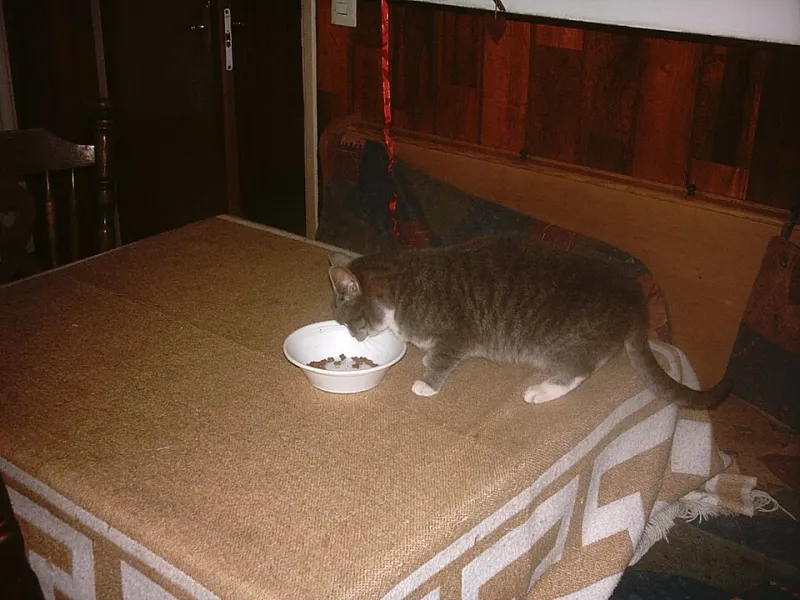
Photo: Unknown, CC BY 1.0, via Wikimedia Commons
For many American cat owners, the sound of a cat retching in the early morning hours has become background noise. Surveys of feline households routinely find that owners consider occasional vomiting to be a normal feature of cat ownership — an assumption that deserves closer scrutiny. In a meaningful share of cases, the problem does not originate in the stomach at all. It begins at the bowl.
The Mechanics of 'Scarf and Barf'
Cats are anatomically designed to eat small, frequent meals. Their wild ancestors consumed roughly a dozen small prey animals a day, and the domestic cat's digestive tract still expects that rhythm. When a cat is offered one or two large servings from a standard flat bowl, it often bolts its food, swallowing large chunks with very little chewing — cats technically cannot chew kibble the way dogs do; they crush and swallow.
The result is regurgitation: an effortless return of undigested food within minutes of a meal, often in a distinctive tubular shape. This differs from true vomiting, which involves abdominal heaving and partially digested contents. Regurgitation from rapid eating is frequently benign, but it is not something owners should simply accept as normal.
How Bowl Design Influences Eating Speed
The conventional cat bowl — a shallow dish placed on the floor — may actually work against feline physiology.
Whisker stress and shallow dishes. Deep or narrow bowls can brush against a cat's sensitive whiskers, discouraging slow, deliberate eating and prompting hurried bites. Wide, shallow dishes reduce this irritation.
Elevated feeders. Raising the food to chest height encourages a more natural head-and-neck posture, which some owners report reduces post-meal regurgitation. Evidence is largely anecdotal, and raised feeders are not appropriate for every cat — particularly breeds predisposed to bloat-like conditions, though this is rare in felines. A brief conversation with your veterinarian can help determine whether elevation is worth trying.
Slow-feeder and puzzle bowls. These products introduce ridges, mazes, or compartments that force the cat to work for each bite, stretching a two-minute meal across ten or fifteen. For habitual gulpers, they are among the simplest and least expensive interventions available at most US pet retailers.
Food puzzles and foraging toys. Ball-shaped dispensers and snuffle-style mats add a behavioral benefit as well, providing the mental stimulation indoor cats often lack.
Hairballs: A Related but Distinct Problem
Bowl design intersects with another familiar issue: the hairball. Cats that eat quickly and vomit frequently may also swallow more air and groom more anxiously, compounding trichobezoar accumulation. Frequent hairball production — more than one every month or two — is not merely a grooming nuisance. It can signal underlying gastrointestinal motility problems, and in some cases, what looks like a hairball episode is actually chronic vomiting from inflammatory bowel disease or food intolerance.
Feeding Schedule Matters as Much as Hardware
Hardware alone will not fix a cat that is ravenous twice a day. Consider these adjustments:
- Divide daily rations into three or more smaller meals, using an automatic feeder if you are away during the day.
- Offer the largest meal before bedtime to reduce early-morning hunger vomiting, a common complaint among owners of healthy young cats.
- Weigh portions carefully. Free-feeding works for some cats, but in multi-cat households it often produces one gorging cat and one underfed one.
Red Flags That Warrant a Veterinary Visit
Adjusting the bowl and schedule is a reasonable first step, but certain signs call for professional evaluation without delay:
- Vomiting more than twice a week, or any vomiting lasting beyond 24 hours
- Weight loss or a noticeable change in body condition
- Blood in vomit, or vomit containing material resembling coffee grounds
- Diarrhea, constipation, or straining in the litter box
- Lethargy, hiding, or refusal of water
- Attempts to vomit that produce nothing — a possible emergency in cats
Chronic vomiting in middle-aged and senior cats deserves particular attention. Conditions such as chronic kidney disease, hyperthyroidism, pancreatitis, and lymphoma can all present as intermittent vomiting, sometimes for months before other symptoms appear. Bloodwork and imaging can rule these out.
When Medication Enters the Picture
If behavioral and dietary adjustments fail, or if a diagnosed condition drives the nausea, your veterinarian may prescribe an anti-emetic. Modern options, including maropitant and ondansetron, have made managing feline nausea far more effective than in previous decades. These medications are not substitutes for diagnosis; they are tools to keep a cat comfortable, hydrated, and eating while the underlying cause is addressed.
A Practical Starting Point
Before assuming your cat has a delicate stomach, take a week to observe the mechanics of mealtime. Switch to a wide, shallow dish, introduce a slow-feeder, split the daily ration into smaller servings, and keep a simple log of what comes up and when. If the pattern resolves, the bowl was likely the culprit. If it persists, you will have brought your veterinarian valuable data — and your cat a faster path to relief.